

Inside the Permanent Storm
Why every crisis feels like the end of the world and how to break the spell.

Another week and more alerts fill the air around us:
The U.S. government shutdown became the longest shutdown in U.S. history…
Reuters warned the U.S. economy is facing a major test as we enter the holiday season…
The World Economic Forum warned of three impending bubbles in financial markets—AI, crypto, and global debt…
Legacy media warned of a “highly volatile threat landscape” during November elections…
Space-weather forecasters issued a strong geomagnetic storm alert, warning of potential risks to satellites and tech infrastructure today and tomorrow…
Storms everywhere—financial, political, digital, planetary.
Each one different, but together they tell the same story: we’re living inside a permanent forecast of fear.
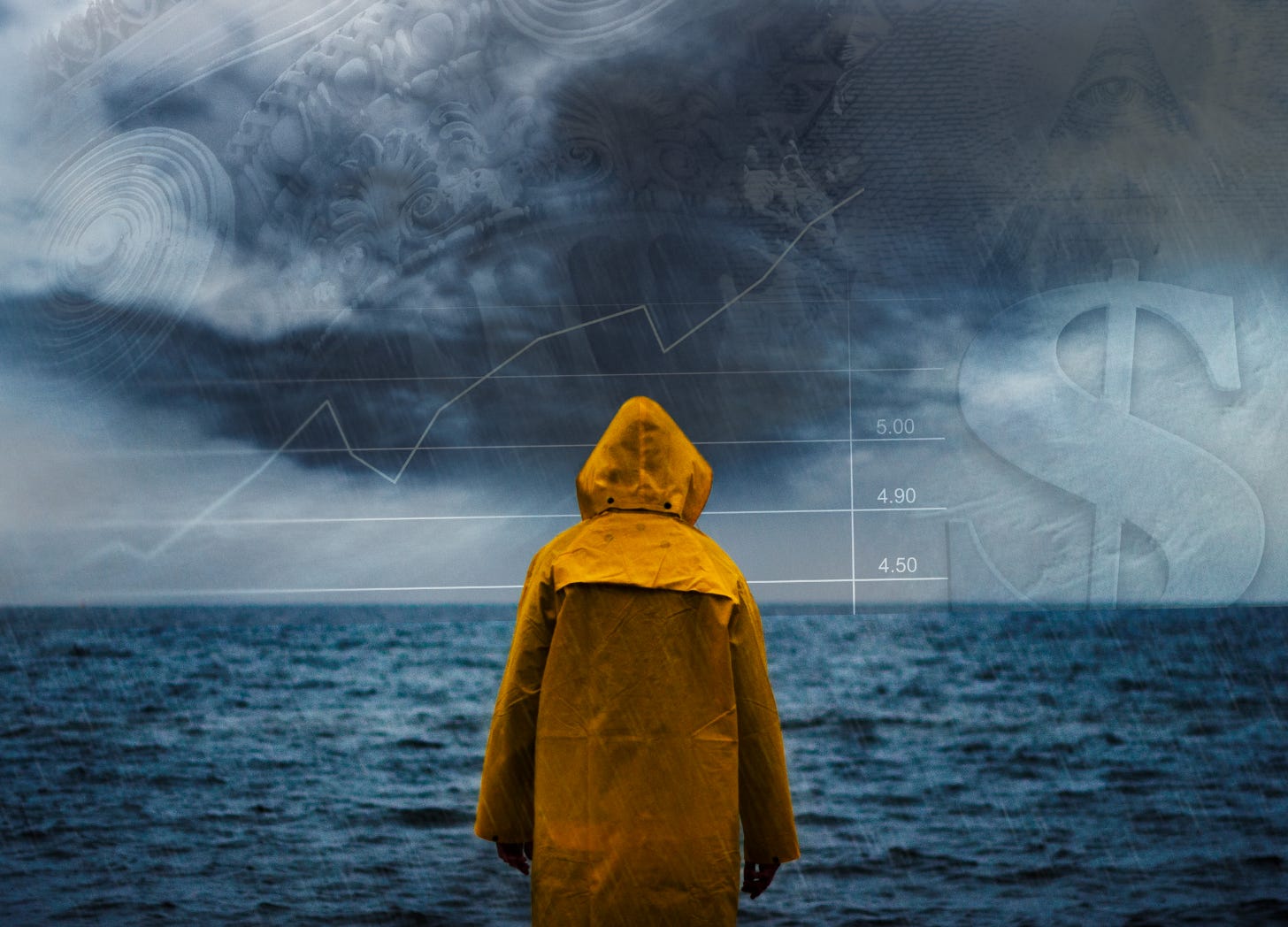
The Pattern
Once upon a time, “storm” meant weather.
Now it’s the default metaphor for crisis.
Scan any major headline:
“Wall Street braces for economic storm.”
“Trump legal storm intensifies.”
“Cyber storm tests federal readiness.”
“Social media storm after viral leak.”
And even when the word storm isn’t used, the language feels the same.
We’re warned of waves of layoffs, shocks to the market, quakes in politics, meltdowns in tech, eruptions of outrage, fires of misinformation, and tsunamis of discontent.
The vocabulary of disaster has become the language of daily life. The sky is always painted dark somewhere.
This isn’t just a media quirk. It’s a psychological pattern that keeps the public braced for impact.
When every sector warns of a storm, a shock, or a wave, you start preparing for everything … and yet end up prepared for nothing.
The Consequence
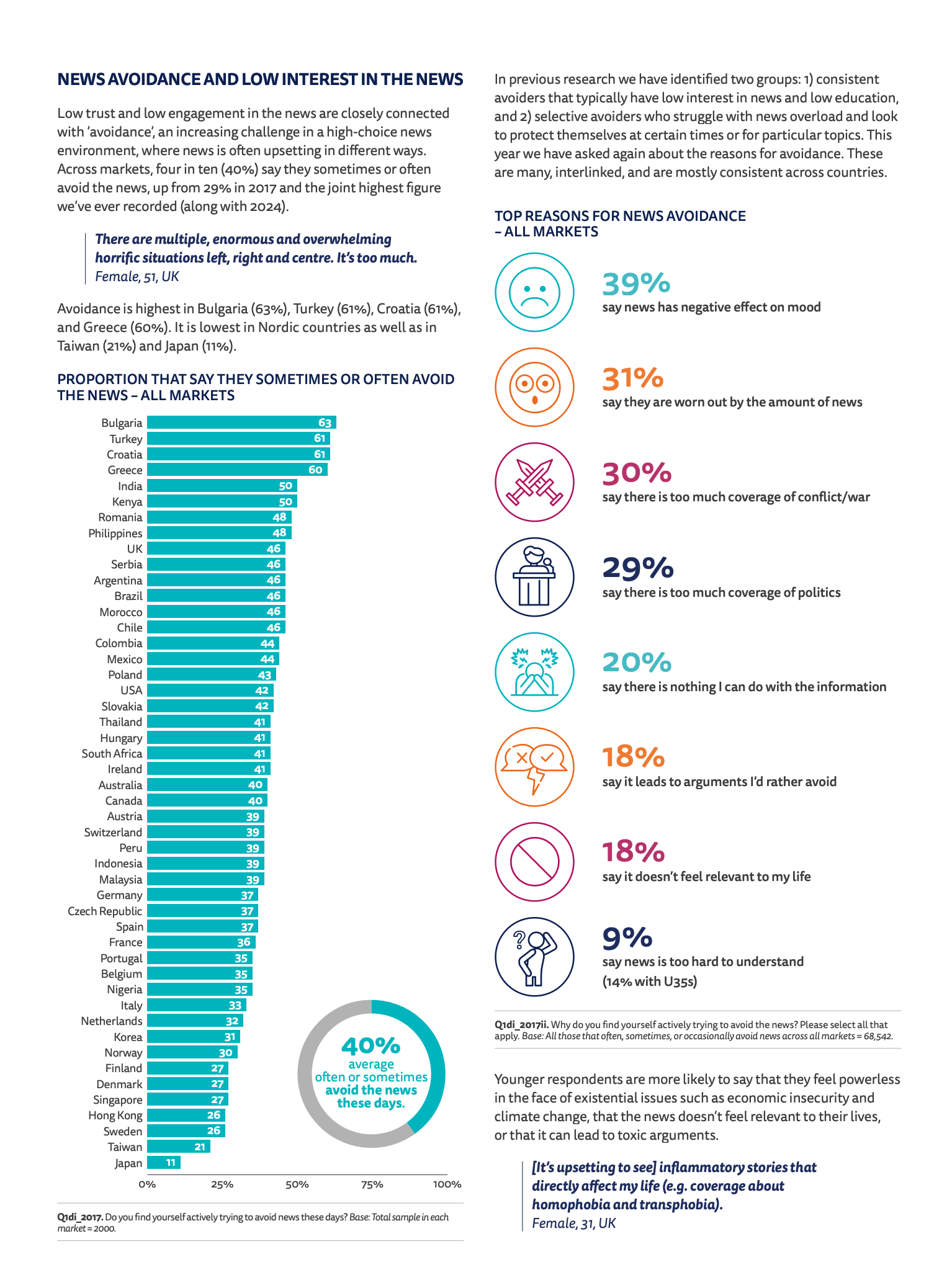
The Reuters Institute’s Digital News Report 2025 notes that 40% of global news-consumers say they sometimes or often avoid the news because it “has a negative effect on their mood” or because “it leads to arguments I’d rather avoid.” (See image below.)
The American Psychological Association reports that three out of four adults describe themselves as chronically stressed—not over one thing, but everything. Economy, politics, health, technology, environment…
That’s a global storm that always hover overhead but never quite lands. And it leads to a constant state that affects normal life and function.

This “permanent storm” culture keeps the nervous system in fight-or-flight mode even when nothing is happening. You scroll, you worry, you tense, you prepare. And the calm part of your biology—the vital one that restores energy, creativity, and empathy—never gets to switch on.
That disconnects us from our inbuilt system of human resilience and instead leads to endless fatigue.
When the Real Storm Hit
A week ago, a storm hit me, knocking out power in my region of upstate New York for thirty-six hours. No heat, no water, no Wi-Fi.
A worried friend texted: “How are you surviving?” My relatives in Australia tried to imagine living two days without electricity.
But for our family, it was a non-event. We lit candles, cooked on gas, and ran the generator for a few hours for showers and warmth. We’ve had worse.
Once you’ve been through the storm, you don’t fear the rain.
But that outage quietly tested everything I’ve been writing about: preparation, perspective, calm. And it reminded me of something the headlines forget:
Real storms eventually pass.
You adapt. You rebuild. You learn.
Yet the endless, imagined storms are harder to survive.
The Real Forecast
If there’s one thing we can count on, it’s more dire warnings:
More financial storms.
More political storms.
More planetary storms.
More mental-health storms.
And many of them will be real.
But others will be amplified or exaggerated simply because fear keeps people watching, clicking, and buying.
That’s the paradox of the modern era: more information, less clarity.
We can’t stop the storms. But we can stop living inside them.
The Revelation
Through writing this, I realized something: Every project I’ve been writing this year—Mind Armor, Human Value, 1-Minute Wonder—has been circling the same truth:
Calm is the solution.
Calm is how you think clearly in chaos.
Calm is how you tell truth in noise.
Calm is how you stay human in systems built to unnerve you.
So I’m bringing my writings all under one name: Calm Rebellion.
Because the most radical act in a storm-driven world isn’t outrage. It’s calm.
New name. Same mission: protect what makes us human.
(And new logo coming next week…)
What makes you calm these days? Or what takes your calm away?
Comment and share your thoughts.
The Takeaway
When you stop bracing for every headline, you start noticing what’s actually happening around you. That’s a sign of discernment, which today, is the modern form of courage.
Because while the world screams “storm” for profit or attention, you can choose calm. Not apathy. Not ignorance. But the calm in the storm that allows you to think clearly, act wisely, and keep your humanity intact.
In This Week’s Darker Details
We dig into the invisible system that profits every time you feel tense. It’s called the cortisol economy: a loop of alerts, noise, and “wellness” fixes that keep your body slightly on edge. I break down how that cycle works, what it does to your health, and how calm quietly breaks it.
👉 Read the full Darker Details post here: The Cortisol Economy: Why Calm Doesn’t Trend

Till next week,
Stay calm. Stay strong. Stay human.
~ Kay
PS. Comments are open to all. Join the discussion! And share this message with someone you know who may benefit from more calm in today’s storms.
I'm with Kevin. Go outside, get some fresh air, look up. This is how I achieve perspective and it's instantaneously calming. I listen to all the non-human critters around me that do not follow social media or watch the news. They constantly fill the air with the beautiful sounds of life. And death. No matter what the headlines and trolls say, modern human life is pretty good — mostly we are not food.
Keeping AWE amidst the AWRY! The daily invitation. https://rogerarendse.substack.com/p/how-often-do-we-let-in-experiences?utm_source=share&utm_medium=android&r=ql0vi&triedRedirect=true