

Are You Him? Or Do You Know Him?
The Hidden Crisis Facing Young American Men

Do you know a man between the ages of 15 and 34?
Are you one?
Then this matters more than you might think.
Because right now, one in four young American men say they feel lonely a lot—not just once in a while. A lot. And it’s not just a few bad days. It’s a way of life for millions.
This isn’t happening everywhere. It’s worse in America than in any other wealthy nation Gallup surveyed. And young women aren’t reporting the same trend.
So what’s going on?
A Generation Drifting Without a Map
There are more apps than ever to connect us. More resources for mental health. More conversations about vulnerability and support.
And yet—young American men are the loneliest.
It’s not just a feeling. It’s a warning light—flashing red.
Because loneliness doesn’t exist in isolation. It feeds on hopelessness. It pairs with numbness. And it can grow into something darker: addiction, withdrawal, depression, or rage.
So the question isn’t just why young men are lonely.
The real question is:
What have we taken away from them?
Not Just About Social Media or COVID
Sure, the pandemic hurt. It ripped people out of routines and buried some in digital caves they haven’t crawled out of. Social media doesn’t help either—curated lives, fake dopamine, endless comparison.
But that’s not the root.
The real cause runs deeper.
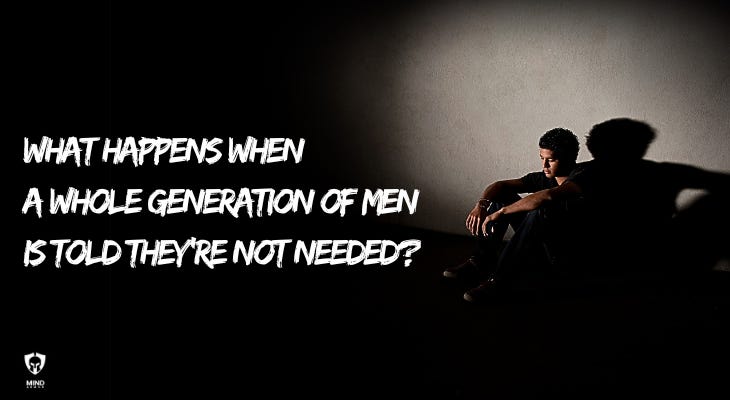
What happens when a young man:
Is told his natural drive to lead is “toxic”?
Feels punished for being assertive?
Is told to sit still, follow rules, and be less of who he is?
Sees no path toward purpose—just pressure, performance, and silence?
What happens is this:
He disconnects.
Not just from others—but from himself.
The Brain Is Wired for Mission
Here’s something the mainstream mental health world isn’t saying clearly enough:
The male brain between 15 and 34 is in the middle of an epic transformation.
The prefrontal cortex—the command center for judgment, planning, and self-regulation—is still developing. It’s also the phase of life when dopamine levels surge, pushing young men toward risk, novelty, and proving themselves.
That’s not immaturity. That’s biology.
It’s the engine of adulthood.
Men at this age need more than safety. They need challenge.
They need to know:
What am I here for?
Who counts on me?
What do I stand for?
If no one gives them those answers, they start asking dangerous ones instead.
We Used to Know This
Historically, cultures had an answer.
Young men were given roles, rituals, and missions.
They were asked to build, protect, sacrifice, and lead.
Even in peacetime, there were rites of passage. A moment when the world said: You are needed. You are responsible. Step up.
Today?
We delay adulthood.
Mock masculinity.
Blur the lines between boy and man, strength and danger, instinct and shame.
And we wonder why young men don’t feel like they belong.
They used to leave the house at 18 to start their lives.
Now many are told to wait—to be careful, compliant, and quiet.
Their deepest instincts—to serve, to fight for something, to create meaning—are either medicated or mocked.
And it’s killing them on the inside.
What No One's Talking About
Let’s stop pretending this is just about mental health access.
It’s about meaning.
Young men don’t just need better therapists.
They need truth and trust.
They need to know:
That their strength isn’t something to apologize for.
That their frustration might be righteous.
That their desire to protect, to build, to win—isn’t a flaw. It’s a calling.
This generation is being raised with no enemies, no map, and no mission.
So of course they feel invisible.
Of course they feel unmanly.
Of course they feel alone.
They’ve been told their nature is dangerous, but their surrender is noble.
That is a lie.
What Can We Do?
If you’re reading this, you’re part of the solution.
Mentor a young man. Not with lectures. With presence.
Speak up for real masculinity. Not the cartoon version—real strength: protective, purposeful, self-controlled.
Invite challenge. Not to hurt, but to forge.
Young men don’t need coddling. They need a reason to rise.
Talk to Him.
So I’ll ask again:
Do you know a man aged 15 to 34?
Ask him this:
“Do you feel like the world has a place for you?”
Then listen.
If you’re that man—reply to this message.
Or share in the comments: Is this true for you?
You don’t have to be silent.
Not here.
This is Mind Armor.
🛡️ Protect your mind. Protect your future.
With strength and gratitude,
Kay
P.S.
If this post hit close to home—especially if you're a parent of a boy or young man—don’t miss my free ebook: Defending My Child’s Brain.
It’s designed for parents of kids aged 0–23, and it breaks down what’s happening inside your child’s brain at every stage—and how today’s culture, media, and systems are shaping their sense of identity, strength, and self-worth.
This is more than a parenting guide.
It’s a mental defense manual for raising grounded, resilient kids in a world that often works against them.
🛡️ [Download it free here → LINK]
PPS.
If you like watching YouTube, I’ve got a video version of this email on my channel. Please subscribe, share and help it grow! https://www.youtube.com/@kayrubacek
yea, and what happens when you feel overwhelmed by a life you don't like? Addiction, in various forms, in order to forget what pains you. It's terrible, and somehow, hard to break.
Working in a modern city, or company, is part of the problem. But what else can you do?
Having to endure the behavior of someone at work just to make a living, then how can you be calm?
You are all the time in fight or flight, and compulsive. This then feeds the addiction, because you can't stand this situation and need an escape.
Then loneliness hits as well, making you destabilized.
So true, it seems a Matrix secretly set up to kill manhood in the society, men especially those traditional men are targeted