

Dark AI Developments: The AI Grid Shock.
What Congress Just Learned, and What You Need to Know

The Race Is On
“The United States is in a race to achieve global dominance in artificial intelligence. Whoever has the largest AI ecosystem will set global AI standards and reap broad economic and military benefits.” — America’s AI Action Plan, July 25, 2025
That’s the U.S. government’s own language. An arms race. AI isn’t being framed as an optional technology. It’s being cast as essential to national survival and global power.
Yet just this week (Aug. 26, 2025), Congress received a “frequently asked questions” memo from its own research service explaining the basics:
What is a data center?
How many are there?
How much electricity do they use?
If lawmakers are still learning the fundamentals, don’t feel bad if this is new to you too. But unlike members of Congress, you don’t get the luxury of catching up slowly. The arms race has already begun, and it is impacting your household bills, your grid reliability, and your future choices.
We know from history that global arms races shape daily life for ordinary people like us. That’s why this backgrounder will give you the same crash course Congress just got, plus the broader context they didn’t.
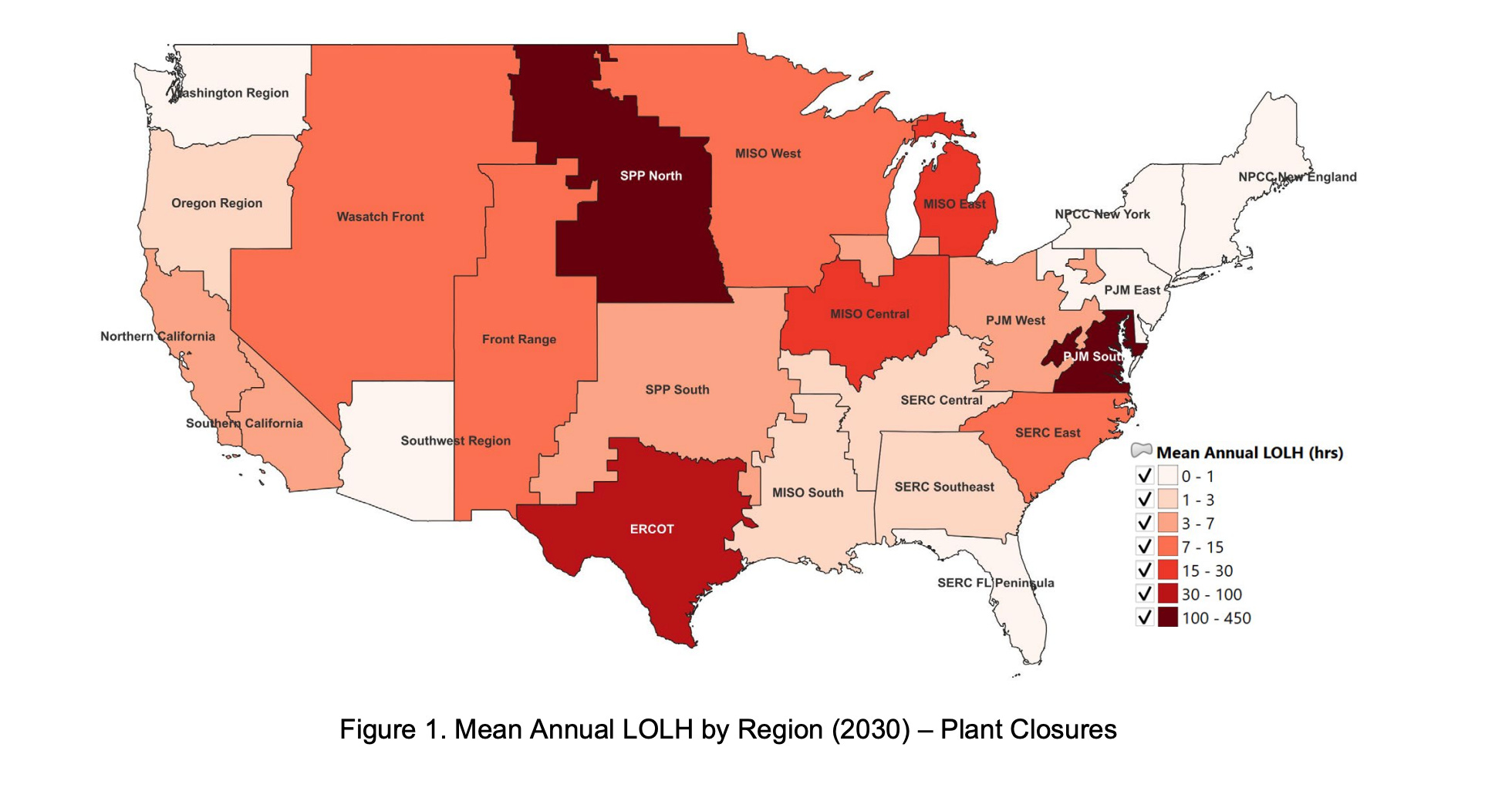
Do you know which grid you get your power from? Read below to know what to expect in your area. (Image DOE)
Residents Are Already Paying
Even before Congress was briefed, ordinary Americans were feeling the costs. Local regulators, utilities, and households across the country have been pointing to AI data centers as a new pressure point on energy prices:
Ohio (2025): Columbus households on standard utility plans began paying about $20 more per month (~$240/year), directly tied to AI data center demand.
New Jersey, Pennsylvania, Ohio (Summer 2025): Monthly bills jumped $10–$27 in Trenton, Philadelphia, Pittsburgh, and Columbus.
Oregon (2024): Utilities warned regulators that customers needed protections from rate hikes linked to data centers.
Mid-Atlantic (2024): Regional power costs surged; households were told to expect up to 20% higher rates in 2025, with data centers cited as a major cause.
For many families, AI isn’t something futuristic. It’s already showing up on the bill.

(From “The AI explosion means millions are paying more for electricity” Washington Post, July 2025)
Are you seeing it on your bill yet?
Comment below.
AI Is Not Intangible: It Runs on Physical Power
Artificial intelligence feels like it’s floating in the cloud—weightless, instant, “free.” Type a question, get an answer. No one sends you a receipt for the electricity behind it. But in reality, every AI interaction is powered by massive data centers inside buildings the size of football fields, filled with racks of servers that never sleep.
The hidden costs:
A Google search uses about 0.3 watt-hours of electricity.
An AI chatbot query (like ChatGPT) can use up to 10 times more. Around 3 watt-hours.
Training a single large AI model can consume as much electricity as hundreds of U.S. households use in a year.
And computing power is only getting hungrier. Chips designed by companies like Nvidia are consuming more kilowatts per server to handle ever-larger models.

(From “The Billion-Dollar Price Tag of Building AI” Time Magazine, June 2024)
The transparency problem:
Before 2022, many AI companies regularly published detailed reports on how much energy their models used. But after ChatGPT’s launch in late 2022, disclosures dropped. Today, most companies no longer release hard numbers. Analysts are left to piece together estimates from hardware specs and scattered company statements.
This lack of transparency makes it harder for lawmakers (and the public) to know what’s really happening to the grid. What’s clear is that “the cloud” is anything but intangible.
AI computing is physical, resource-hungry infrastructure, and we all share the costs.
What Are Data Centers?
To understand why bills are rising, it helps to know what Congress just learned. The Aug. 26 memo from the Congressional Research Service (CRS) offered lawmakers a crash course:
Definition: A data center is a specialized building that houses computer servers, storage devices, and networking equipment. These facilities power the internet, financial systems, cloud storage, streaming platforms, and now artificial intelligence.
Number: There are about 7,000 worldwide. The U.S. has the largest share, with an estimated 3,000 or so, especially in Northern Virginia (the world’s biggest concentration), Texas, and other hubs.

(Chart from Grid Strategies)
Power Use (2022): U.S. data centers consumed about 176 terawatt-hours (TWh) of electricity, roughly 4% of all U.S. electricity use—more than many entire states.
Projected Growth:
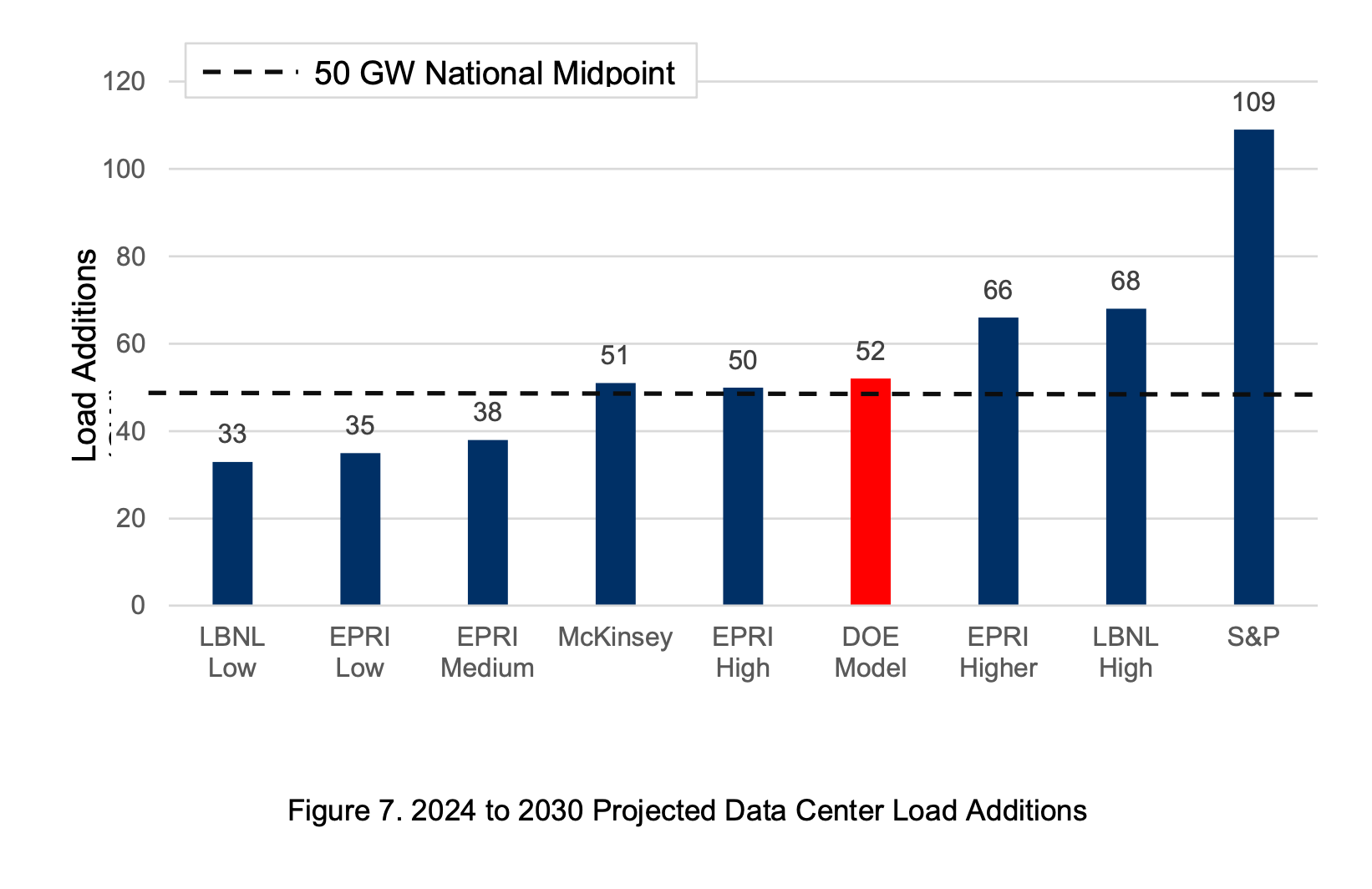
The Department of Energy’s midpoint estimate is an additional +50 gigawatts (GW) of demand by 2030.
That’s the same as powering every home in California.
Other estimates range from 35 GW (low) to 108 GW (high).
Cooling:
In hot regions, air conditioning drives up energy use.
In drought-prone areas, water cooling competes with households and farms for scarce water.
Scale comparisons:
Megawatt (MW): enough to power about 750 homes.
Gigawatt (GW): enough to power about 750,000 homes.
A single hyperscale data center can draw 100–500 MW—enough to power a mid-sized city.
Congress’s need for a primer shows how new and complicated this issue is, even for policymakers.
Big Tech’s Buildout
While lawmakers are still learning the basics, industry isn’t waiting:
Google, Meta, Amazon, and Microsoft plan to spend over $350 billion in 2025 building and equipping AI data centers.
For context: the Apollo moon program cost around $25 billion at the time ($180 billion in today’s dollars).
Nvidia continues to produce chips that use more kilowatts per server to train and run larger models.
Local economies see short-term jobs from construction, but once operational, data centers employ relatively few people, so they aren’t leading to long-term job growth.
The Executive Branch of the U.S. Government Has Been Preparing All Year
While Congress is catching up, the executive branch has been treating this as a national security issue since January:
Jan 20, 2025: Declaring a National Energy Emergency. (No mention of AI data centers.)
Apr 8, 2025: Strengthening the reliability and Security of the United States Electric Grid. The Department of Energy (DOE) was instructed to project how AI growth will affect the grid.
Jul 2, 2025: The DOE released it’s Resource Adequacy Report, Evaluating the Reliability and Security of the United States Electric Grid, warning:
Expected +50 GW demand by 2030.
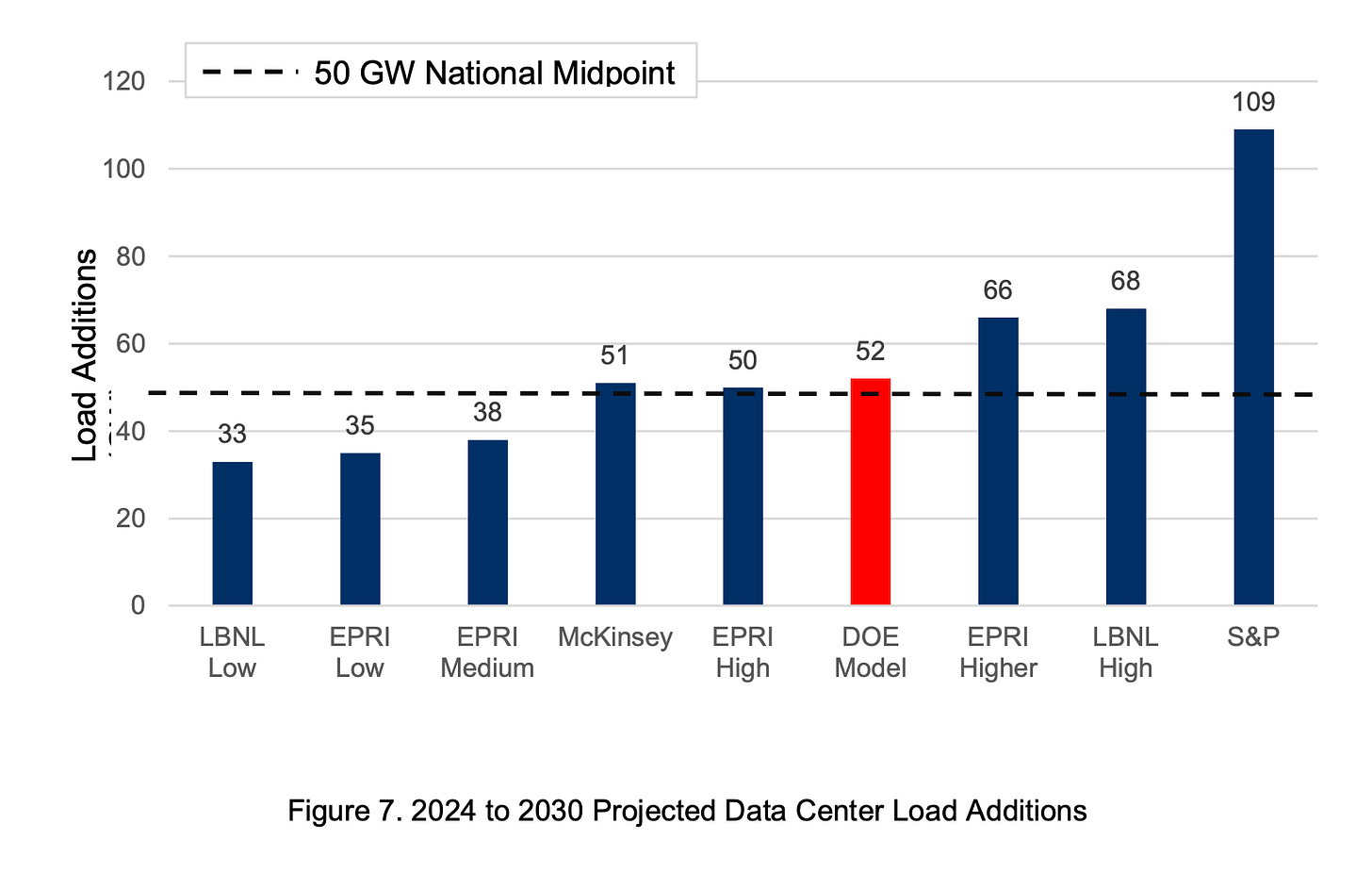
(Estimates for expected power demands vary widely. The DOE took a midpoint of 50GW)
“Retirements plus load growth increase risk of outages by 100x.”
“Status quo is unsustainable.”

(Expected outages of hours per year if nothing is changed on the current trajectory. Source: DOE)

(Expected outages of hours per year if power plants that were scheduled to close early do not shutter early. Source: DOE)
Jul 23, 2025: Accelerating Federal Permitting of Data Centers to “utilize federally owned land and resources for the expeditious and orderly development of data centers.”
Jul 24, 2025: DOE Announces Site Selection for AI Data Center and Energy Infrastructure Development on Federal Lands
“We are taking a bold step to accelerate the next Manhattan Project—ensuring U.S. AI and energy leadership,” said Energy Secretary Chris Wright.
Jul 25, 2025: The White House releases Winning the Race AMERICA’S AI ACTION PLAN.
”American energy capacity has stagnated since the 1970s while China has rapidly built out their grid. America’s path to AI dominance depends on changing this troubling trend.”

(This chart from Grid Strategies shows the change in U.S. power demands since the 1950s)

(Chart from Grid Strategies)
Historical Context
History shows us what it means when government frames an issue as an arms race:
World War II: Families accepted rationing as part of the war effort.
Cold War: Decades of higher defense spending were normalized as the price of survival.
Manhattan Project: Enormous resource demands justified as existential.
AI is now framed the same way. Costs to citizens—higher bills, greater risks—are recast as sacrifices for the “greater good.”
Timeline of the AI Arms Race
This arms race didn’t start with policy. It started with a product: ChatGPT.
Nov 2022: ChatGPT launched, triggering the generative AI boom.
2023–2024: AI adoption exploded across industries; global investment surged.
2024: Utilities began linking higher household bills to data centers (Oregon, Mid-Atlantic, South Carolina).
2025: China’s DeepSeek launched. It achieved efficiency gains with fewer GPUs and lower costs, increasing competitive pressure on the U.S.
Jul 2025: The U.S. formalized the race with America’s AI Action Plan.
The U.S. Power Grid Under Pressure
Most people don’t think about the grid until the lights go out. But it’s worth knowing a few basics, because the grid is where the AI arms race meets your everyday life.
What is the U.S. grid?
The United States doesn’t run on a single national grid. Instead, it has three major “supergrids”:
The Eastern Interconnection (everything east of the Rockies).
The Western Interconnection (everything west of the Rockies).
The Texas grid (ERCOT), which operates largely on its own.
Within those supergrids, electricity is actually managed day to day by regional transmission operators (RTOs) and independent system operators (ISOs). These are the organizations that balance supply and demand, run the electricity markets, and handle reliability for their regions.
In the East, examples include PJM Interconnection (covering parts of 13 states from New Jersey to Illinois), MISO (covering much of the Midwest and South), ISO-NE (New England), and NYISO (New York).
In the West, CAISO (California ISO) runs most of California’s grid, while other parts of the Mountain West and Northwest are managed by federal power agencies like BPA (Bonneville Power Administration) and WAPA (Western Area Power Administration).
Texas is managed almost entirely by ERCOT (Electric Reliability Council of Texas).
For citizens, this means your grid experience is local. While we talk about the “big three” supergrids, your reliability and rates are shaped by the RTO or ISO where you live.


(Charts from Grid Strategies)
How reliable are they now?
On average, the U.S. grid experiences 1–2 outages per household per year, usually short-term (from storms, equipment failures, or maintenance).
But larger rolling blackouts have become more common in the past decade, especially during extreme weather events.
The Department of Energy’s July 2025 report warns that with rising AI demand, outages could increase 100-fold by 2030 if nothing changes. That would mean major, recurring blackouts across large regions, not just occasional storm-related outages.
The challenges
Rising demand: Data centers already use about 4% of U.S. electricity; projections show they could require an additional 50 gigawatts by 2030—the equivalent of every home in California.
Plant retirements: Coal and nuclear plants are being closed faster than replacement power is being added. This shrinks the “cushion” the grid needs to handle spikes in demand.
Regional bottlenecks: Growth is concentrated in a few hubs (like Northern Virginia in PJM territory and parts of Texas in ERCOT), creating local vulnerabilities where demand is outpacing infrastructure.
Cooling competition: Data centers in hot or dry areas use huge amounts of electricity for cooling—or draw heavily on local water supplies. Both strain surrounding communities.
The options ahead
Citizens and policymakers face stark choices:
Continue as we are. Keep retiring plants while demand soars. Result: frequent blackouts and skyrocketing rates.
Slow or stop plant retirements. Keep older coal and nuclear facilities online longer than planned, accepting the environmental and political trade-offs.
Massively accelerate new supply. This means building large numbers of new plants (renewables, nuclear, gas) and expanding transmission lines—on a timeline faster than anything the U.S. has achieved in decades.
Reduce or redistribute demand. Require data centers to build near abundant clean power sources, or limit how quickly new ones can be connected.
None of these paths are simple or painless. But without a major change, the Department of Energy says the status quo is “unsustainable.”
Recommendations for Us All
You don’t need to be an engineer to take practical steps:
Know your grid: Find out who operates it (PJM, ERCOT, etc.). Each region has different vulnerabilities.
Track your bill: Look for unexplained increases—it may reflect new data center demand in your area.
Raise questions: Contact representatives about consumer protections.
Plan resilience:
Backup power (generators, solar + battery).
Reduce dependence on a single power source.
Build community: Outages are easier to endure with neighbors you know and trust.
Stay informed: Policy moves are happening quickly; consumers will feel the effects first.
Stay strong. Stay kind. Stay human.
~ Kay
Learned several weeks ago that in "Power outage" crisis, data centers will not be affected, causing more of outage share for individuals and non-essential businesses..