

AI Lost to a 9-Year-Old — Here’s Why That Matters
Inside a quiet study, something extraordinary happened: a group of children beat artificial intelligence at its own game...

While tech giants are racing to build AI that can think better than humans, one group of researchers decided to try something different.
They handed the challenge to kids.
Not coding prodigies.
Not math geniuses.
Just regular children between the ages of 7 and 11.
And what happened?
The kids won.
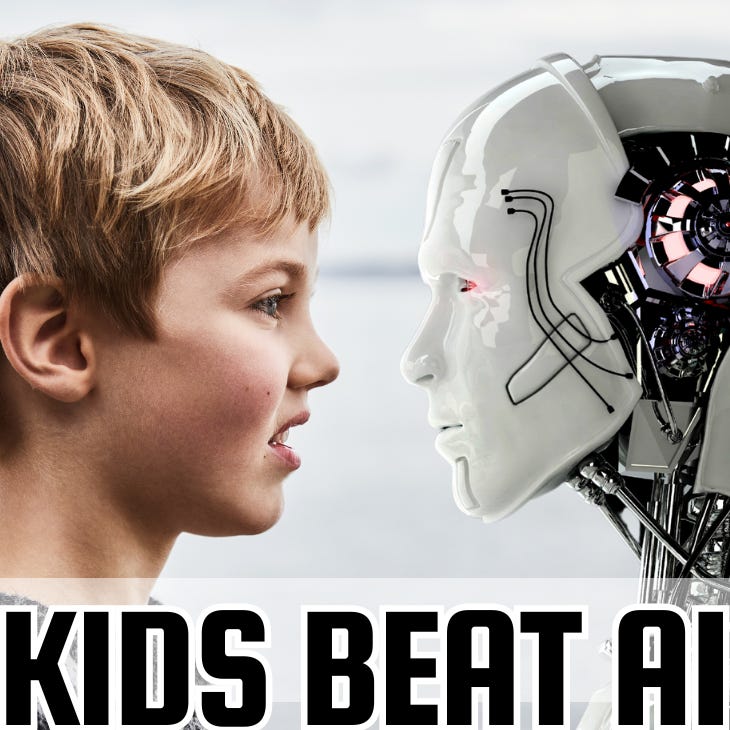
🧩 The Puzzle That Tricked the Machine
At the University of Washington, researchers created a game called AI Puzzlers. It’s based on something called ARC puzzles — visual logic problems designed to test reasoning skills without relying on words or math.
The kids played the game by solving puzzles on their own. Then they asked AI to solve the same puzzle. Often, the AI would get it wrong. Badly wrong. But it sounded confident. Polished. Convincing.
Still, the kids could see it. They weren’t fooled.
One child said it best: “AI just keeps guessing.”
And then they did something incredible: they started helping the AI improve.
They reworded their prompts. Compared model versions. Looked for patterns.
They were learning — not just how to solve puzzles, but how to think better than a machine.
🧠 Why It Matters
Most adults today assume that if AI sounds confident, it must be right.
But these kids? They saw through it. And that’s the point.
These weren’t coding lessons. This wasn’t about teaching children how to use AI. This was about something far more powerful: Teaching them how to think in a world full of tools that will try to think for them.
It’s one of the most important skills we can give a child. And it might just be the skill that protects them from manipulation, misinformation, and mental laziness later in life.
😈 But Here’s the Twist…
There’s another side to this story.
What if this kind of research doesn’t just make kids smarter?
What if it also makes AI smarter than the kids?
Think about it: By watching how children beat AI at reasoning, developers can feed that knowledge right back into the machine.
It’s happened before:
Human chess games helped train AI that now destroys grandmasters.
Human driving data helped build self-driving cars.
Human writing trained the large language models we use today.
So what’s to stop developers from using these child vs. AI comparisons to close the gap even faster?
The same insights that help kids develop critical thinking… could be used to train AI to mimic (and eventually surpass) that thinking.
That’s the paradox.
We’re teaching kids how to beat the machine — but we may also be showing the machine how to beat us.
⚖️ So What Do We Do?
We don’t stop teaching kids to think. We double down on it.
Because no matter how advanced AI becomes, it still can’t replicate the one thing only humans have: awareness.
The ability to reflect, to question, to pause — and to choose.
This research proves that even a child can outperform a billion-dollar algorithm…
as long as they’re trained to trust their own brain. And that’s what really matters.
🛡 Want to Help Your Child Build This Skill?
If you’re a parent, educator, or just someone concerned about how fast AI is growing, I created a free resource for you:
🎁 Download my free guide: Defending My Child’s Brain
It’s a practical, science-based eBook that shows you how to:
Strengthen your child’s critical thinking
Spot the early signs of digital overtrust
Build a resilient mindset in the AI age
Because protecting a child’s mind isn’t about fearing technology. It’s about giving them the tools to rise above it.
AI might be smart. But your child’s brain — when nurtured — is wiser.
Let’s keep it that way.